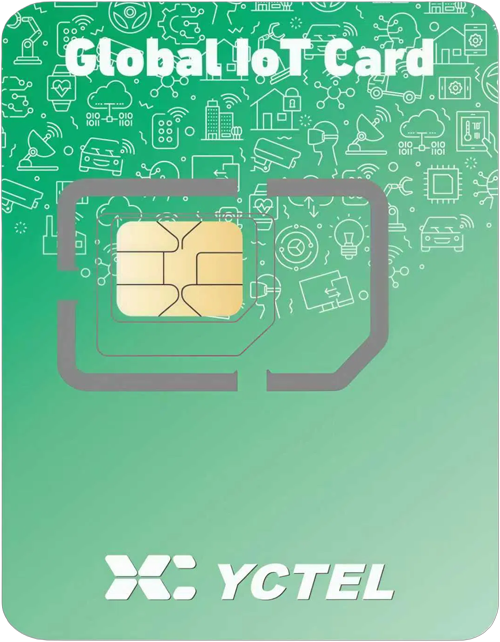
Technology : All YCTEL cards (Green, Orange, Purple, Black) are compatible with any available cellular tower technology, including (5GNR, 4GLTE, 3G HSPA+, and 2G GSM). The card itself does not dictate the technology; rather, it is the IMSI provider that does so. Currently, CAT 1 LTE technology is utilized in 99% of PoC radios.
Network Carriers: As previously mentioned, the vendor is responsible for determining the carriers, and this selection influences the price that a vendor incurs. Budget SIM has selected two options tailored to your requirements – 1.0 features connections to AT&T and T-Mobile across all available towers, while 2.0 includes Verizon as an additional option. Both variants of the cards provide excellent value and can be acquired from us.
Protection: This is where it becomes somewhat trivial; the SIM card connects to the carrier, and the carrier’s system (referred to as the biller) manages all security, firewalls, etc. I apologize for any disappointment, but there is little to elaborate on in this regard.
NFCs?: “What? NFC, or ‘Near Field Communication,’ is a device option that is not even related to the SIM.
Voice?: It is worth noting that YCTEL does not provide VoLTE voice services, leaving one speechless.
Auto APN: “Access Point Name” refers to a device command that depends on the module to store AUTO APNs from the provider. Both 1.0 and 2.0 cards support AUTO APN.
Packet Flow and Stability: Data transmission for a device typically averages 96 Kbps, and the stability of this data flow is contingent upon the CARRIER to which the device is connected. While CARRIER direct SIM cards will consistently have data preference over IoT providers, at 96 Kbps, you will likely not perceive any difference in your RTOS walkie-talkie. This is yet another topic, and both the 1.0 and 2.0 cards are identical.
Vendor desperation at its finest. Simple truth – There is no difference.